How to Write a PEEL Paragraph: Step-by-Step Guide With Australian University Examples
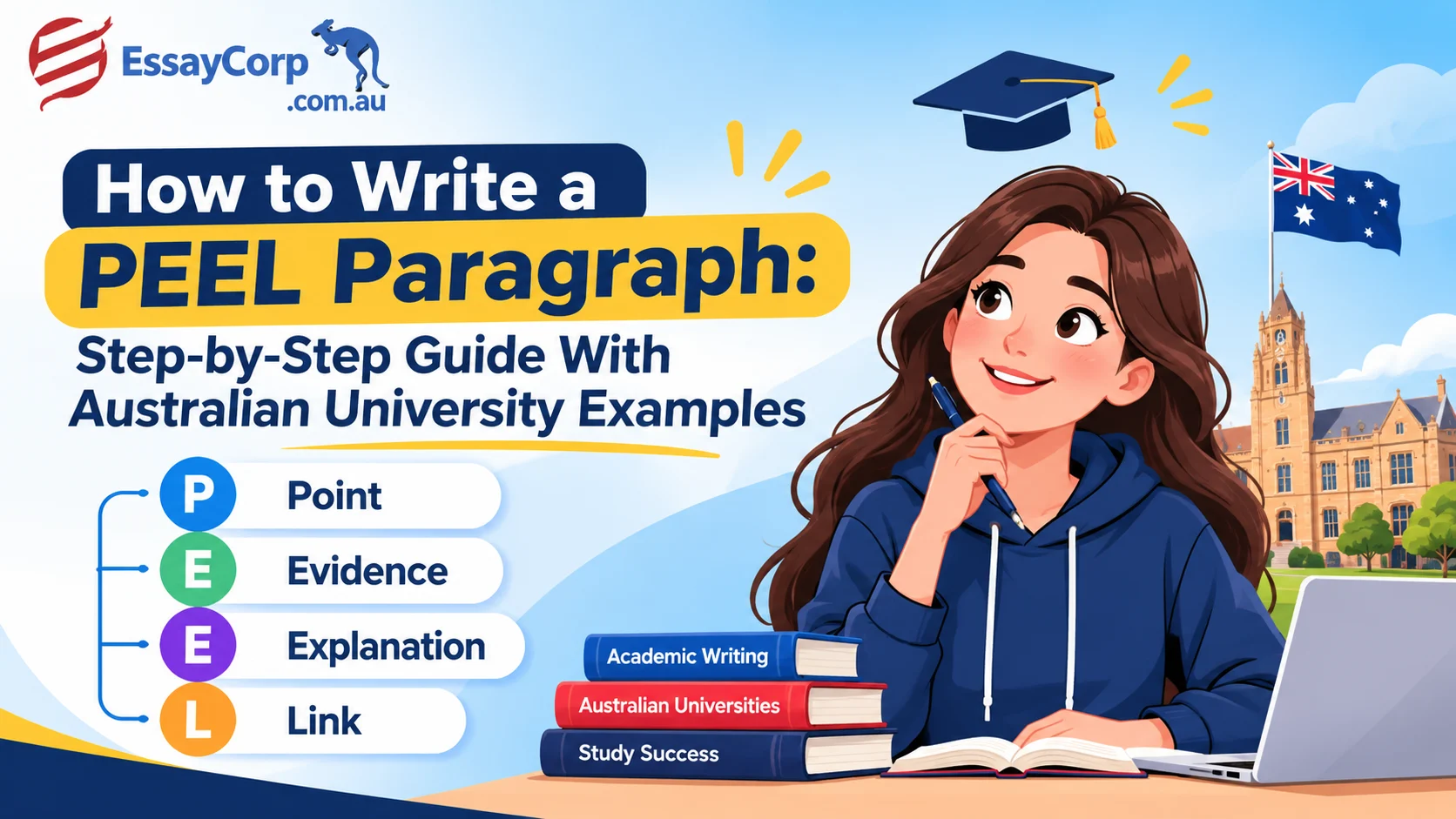
Quick answer: To write a PEEL paragraph, open with a Point (one clear claim), support it with Evidence (a cited source or case fact), Explain why that evidence proves your point, then Link back to your essay question or thesis. Each paragraph should carry one idea and finish with a clear connection to your argument.
If you have ever received feedback like “too descriptive”, “needs more analysis” or “unclear argument” on a university essay, your paragraphs are probably missing one of those four moves. This guide shows you how to write a PEEL paragraph in six practical steps. It includes original examples from nursing, law, management, marketing and economics, plus a template, a checklist and the mistakes that cost marks most often.
Whether you study at USYD, UNSW, UniMelb, UQ, Monash, RMIT or a regional campus, the same logic applies. Markers reward students who make a claim, prove it and explain why it matters. If you are juggling several deadlines, you can also explore assignment help in Australia for subject-matched guidance alongside your own study.
What Is a PEEL Paragraph?
A PEEL paragraph is a four-part paragraph structure: Point, Evidence, Explanation, Link. It helps students present one focused argument per paragraph, support it with credible sources, analyse that support and connect it back to the essay question.
PEEL is widely taught in Australian schools and is carried into first-year university study through learning-skills units and writing guides. It works because an academic essay is really a sequence of claims, each backed by proof.
The four parts of PEEL
-
P: Point. A topic sentence that states the single idea of the paragraph. It should be arguable, not just descriptive.
-
E: Evidence. A scholarly source, statistic, legislation, case law, clinical guideline or case-study fact that supports your point. It is paraphrased and referenced.
-
E: Explanation. Your own analysis. Say what the evidence means, why it matters and how it proves your point.
-
L: Link. A closing sentence that ties the paragraph back to the question, or leads into the next paragraph.
PEEL vs TEEL vs PEEEL: what’s the difference?
You will meet several acronyms across unit guides. They all describe the same logic.
|
Structure |
Stands for |
Best used for |
|
PEEL |
Point, Evidence, Explanation, Link |
Most essays, reports and case studies |
|
TEEL |
Topic sentence, Explanation, Evidence, Link |
Essays where you introduce the concept first, then prove it |
|
PEEEL |
Point, Evidence, Explain, Evaluate, Link |
Higher-level analysis where you weigh the evidence |
If your unit guide uses a different acronym, don’t panic. Check the marking rubric and make sure every element is present. This is also where assessment help can clarify what your marker expects.
Why PEEL Paragraphs Matter at an Australian University
PEEL matters because Australian marking rubrics reward clear argument, credible evidence and critical analysis, and a well-built paragraph shows all three in a few sentences.
1. Rubrics reward analysis, not description
Most university rubrics separate “knowledge and understanding” from “critical analysis and evaluation”. A paragraph that only reports what a source says earns marks in the first column and loses them in the second. The Explanation step is where you earn the second set.
2. Assessment integrity is under a brighter spotlight in 2026
Australia’s higher education regulator, TEQSA, signalled a shift from an educative approach to a regulatory-led approach to generative AI and assessment integrity beginning in 2026. Universities are redesigning assessment to confirm that students can reason for themselves, with more supervised tasks, vivas and process evidence. Writing paragraphs that show your own thinking is both a marks strategy and a protection strategy.
3. Markers read quickly and skim for structure
A marker working through dozens of scripts looks for topic sentences first. A strong Point at the start of each paragraph tells them straight away that you have a position.
4. PEEL transfers across disciplines
The labels change by subject, but the logic does not. In law it sits inside IRAC. In nursing it supports evidence-based practice. In business it shapes case-study analysis.
How to Write a PEEL Paragraph: 6 Steps
To write a PEEL paragraph, decide your single point, find one strong piece of evidence, paraphrase and reference it, explain its significance, link back to the question, then edit for flow and word count.
Step 1: Break down the question and rubric
Before drafting, underline the task words (analyse, evaluate, discuss, critically assess) and check the rubric weightings. Your paragraph plan should mirror the marks available.
-
Identify the task word. “Evaluate” needs judgement, while “describe” does not.
-
Note the limiting words (a sector, time period, jurisdiction or theory).
-
Check the word count to estimate how many paragraphs you can afford.
If you need help translating a brief into a plan, a subject-matched expert can guide you through coursework help before you start writing.
Step 2: Write a sharp Point (the topic sentence)
Your Point should be one sentence, arguable and tied to the question.
-
❌ “This paragraph is about workplace culture.”
-
✅ “Inclusive leadership practices improve retention in Australian hospitality businesses because they strengthen employees’ sense of belonging.”
Test: If a reader could reasonably disagree with your Point, it is doing its job.
Step 3: Choose and introduce your Evidence
Strong evidence is relevant, current and credible.
-
Peer-reviewed journal articles and academic books
-
Government and regulator publications
-
Legislation and case law (for law students)
-
Professional standards and clinical guidelines (for nursing and health)
-
Company annual reports and industry data (for business, finance and accounting)
-
Case-study facts supplied in your assessment brief
Introduce the source with a signal phrase and then paraphrase it, for example “Smith (2023) found that…” or “According to the Fair Work Act 2009 (Cth)…”. Use direct quotes sparingly and only when the exact wording matters. Always follow your unit’s referencing style, such as Harvard AU, APA 7th or AGLC4.
Step 4: Explain the Evidence (the step most students skip)
This is where marks are won. Answer these questions in your own words:
-
What does this evidence show?
-
Why does it support my point?
-
What is the cause, effect or implication?
-
Are there limitations or competing views?
A reliable formula is “This suggests that… because… which means…”.
Step 5: Write the Link
Finish the paragraph by connecting it to your thesis or the next paragraph.
-
“Therefore, strengthening induction processes directly addresses the question of how organisations reduce early turnover.”
-
“This limitation leads into the second factor, which is regulatory pressure.”
Avoid generic endings like “In conclusion, this shows that it is important.” The Link should be specific to your argument.
Step 6: Edit for flow, length and referencing
-
Aim for 120–200 words per paragraph, unless your unit guide says otherwise.
-
Check that you have one idea only.
-
Use transition words (however, consequently, in contrast, similarly) sparingly and meaningfully.
-
Verify that each in-text citation matches an entry in your reference list.
PEEL Paragraph Examples From Australian University Subjects
These original PEEL paragraph examples show how the structure adapts to different Australian university disciplines. In each one, the four elements are labelled so you can see where they sit. Citations are illustrative, so always replace them with sources you have read and verified yourself.
Example 1: Nursing (patient-centred care)
Question: Discuss the importance of person-centred communication in Australian clinical practice.
(P) Person-centred communication is essential in Australian nursing practice because it directly improves patients’ understanding of, and participation in, their own care. (E) Studies of acute-care wards report that patients who receive clear explanations and are invited to ask questions show greater adherence to treatment plans (Author, 2022). (E) This suggests that communication is not simply a courtesy but a clinical intervention: when patients understand why a medication or procedure is needed, they are more likely to follow it, which reduces avoidable readmissions. Registered nurses are also expected to meet professional standards that emphasise respectful, culturally safe partnerships with patients. (L) Consequently, embedding communication training in clinical education supports the broader aim of safe, evidence-based care.
Why it works: One idea, a clear mechanism (understanding leads to adherence, which leads to fewer readmissions) and a link to professional standards. Students working on placement reflections or clinical case studies can see how this applies in nursing assignment help and in aged care assignment help contexts.
Example 2: Law (directors’ duties)
Question: Critically evaluate the standard of care expected of company directors in Australia.
(P) Australian law sets a demanding but flexible standard of care for company directors. (E) Section 180(1) of the Corporations Act 2001 (Cth) requires directors to exercise their powers with the care and diligence a reasonable person would exercise in the same position, while s 180(2) offers a business judgment rule defence where decisions are made in good faith, for a proper purpose and on an informed basis. (E) The two provisions work together: the objective standard prevents carelessness, but the defence protects reasonable commercial risk-taking. Without the rule, directors might avoid worthwhile ventures out of fear of liability, which would harm shareholders. (L) This balance is central to assessing whether the statutory duty is effective, as discussed in the next section on enforcement.
Why it works: The statute is the evidence, and the Explanation shows the policy reasoning. In law assessments, PEEL often sits inside the Rule and Application steps of IRAC, and you can see how that looks in law assignment help with correct AGLC4 referencing.
Example 3: Management (organisational change)
Question: Evaluate why change initiatives fail in large Australian organisations.
(P) Change initiatives in large Australian organisations frequently fail because leaders underestimate employee resistance. (E) Kotter’s (1996) change model identifies insufficient communication of the vision as a common error, a pattern echoed in the case study where staff at the retailer first learned of the restructure through the media. (E) The case shows that a lack of early engagement left employees uncertain about job security, which increased resistance and slowed implementation. However, Kotter’s model assumes a linear process, which may not suit fast-moving retail environments, so the framework should be applied with caution. (L) Addressing communication gaps is therefore a prerequisite to the structural recommendations later in this report.
Why it works: It ties theory to case facts and acknowledges a limitation, which is a key marker of critical thinking. For frameworks like SWOT, PESTLE and Porter’s Five Forces, see management assignment help.
Example 4: Marketing (consumer behaviour)
Question: Analyse how social media influences brand loyalty among young Australian consumers.
(P) Authentic social media engagement strengthens brand loyalty among young Australian consumers more than traditional advertising. (E) Research on digital consumer behaviour indicates that user-generated content is perceived as more trustworthy than brand-produced messaging (Author, 2023). (E) This matters because trust is a precondition for loyalty: when consumers see peers endorsing a brand, perceived risk falls and repeat purchase becomes more likely. Nevertheless, over-reliance on influencer partnerships can backfire if audiences detect inauthenticity. (L) Brands therefore need a balanced content strategy, which leads to the segmentation recommendations below.
Why it works: It makes a claim, uses research, explains the psychological mechanism and anticipates a counter-argument. For digital strategy, consumer behaviour and brand-management tasks, explore marketing assignment help.
Example 5: Economics (interest rates and spending)
Question: Explain how monetary policy affects household consumption in Australia.
(P) Changes in the cash rate influence household consumption primarily through mortgage repayments. (E) Because a large share of Australian households hold variable-rate mortgages, adjustments by the Reserve Bank of Australia pass through quickly to disposable income (Author, 2024). (E) When rates rise, higher repayments reduce discretionary spending, which slows aggregate demand and eases inflationary pressure. The strength of this effect depends on household debt levels and savings buffers, so impacts are uneven across income groups. (L) This transmission channel explains why monetary policy is considered a powerful but blunt tool, a point developed in the policy evaluation section.
Why it works: It separates the mechanism from the limitation and links to a broader argument. Similar reasoning appears in economics assignment help and finance assignment help tasks.
PEEL Paragraph Template and Sentence Starters
A PEEL paragraph template gives you a fill-in-the-blank frame you can adapt to any subject. Use it to draft quickly, then rewrite in your own voice.
Copy-and-adapt template
-
Point: “[Concept or factor] is significant in [context] because [reason].”
-
Evidence: “[Author] (Year) found/argued that [paraphrased finding].”
-
Explanation: “This indicates that… because… As a result…”
-
Link: “Therefore, [your point] supports the argument that [thesis/question], which leads to…”
Sentence starters for each element
-
Point: A key factor is… / Evidence suggests that… / It can be argued that…
-
Evidence: According to… / Research by… indicates… / The case shows…
-
Explanation: This demonstrates… / This is significant because… / A possible reason is…
-
Link: Consequently… / This reinforces… / Having established this, the next section examines…
Quick word-count guide
|
Paragraph element |
Approximate length |
|
Point |
1 sentence |
|
Evidence |
1–2 sentences |
|
Explanation |
2–4 sentences (the longest part) |
|
Link |
1 sentence |
From Pass to High Distinction: Making PEEL Critical
To lift a PEEL paragraph from Pass to High Distinction, add evaluation: compare sources, weigh strengths and limitations, and explain the implications of your argument. Following the structure is not enough if your writing remains descriptive.
Descriptive vs critical writing
Before (descriptive)
Leadership is important in healthcare. Smith (2022) says that good leaders improve staff morale. Morale is important for staff. This shows leadership matters.
After (critical)
Transformational leadership improves staff retention in Australian hospitals by increasing perceived support. Smith (2022) found that nurses who rated their managers as supportive reported lower intention to leave. This suggests that retention depends less on pay alone and more on workplace relationships, although Smith’s sample was drawn from metropolitan hospitals, so findings may not apply to rural settings. Addressing this gap is therefore essential when proposing a statewide workforce strategy.
What changed?
-
The Point became specific and arguable.
-
The Evidence became a clear finding.
-
The Explanation added reasoning and a limitation.
-
The Link connected to the larger question.
Quick tip: ask “so what?” after every Explanation. If you cannot answer, the paragraph is probably still descriptive.
Four ways to add critical depth
-
Compare sources: “While Author A argues… Author B contends…”
-
Evaluate quality: consider sample size, date, context and potential bias.
-
Show implications: what does this mean for practice, policy or theory?
-
Acknowledge counter-arguments: then explain why your position still holds.
10 Common PEEL Paragraph Mistakes (and Quick Fixes)
The most common PEEL mistakes are weak topic sentences, evidence without explanation, too many ideas in one paragraph and links that merely repeat the point. Fix these and your marks often rise.
-
Mistake: the Point is a fact, not a claim. Fix: turn it into an arguable statement.
-
Mistake: the quote is dropped in without introduction. Fix: use a signal phrase and paraphrase.
-
Mistake: the evidence is outdated or unreliable. Fix: prioritise recent, peer-reviewed or official sources.
-
Mistake: the Explanation is one line. Fix: expand with cause, effect, implication and limitation.
-
Mistake: several ideas appear in one paragraph. Fix: split into separate PEEL paragraphs.
-
Mistake: the Link repeats the Point. Fix: connect to the thesis or the next idea instead.
-
Mistake: every paragraph looks identical. Fix: vary sentence openers and rhythm while keeping the structure.
-
Mistake: no Australian context. Fix: use local legislation, data, regulators and case facts where relevant.
-
Mistake: inconsistent referencing. Fix: follow one style (Harvard AU, APA 7th or AGLC4) throughout.
-
Mistake: over-quoting. Fix: paraphrase and keep direct quotes short.
Using PEEL in Different University Assessments
PEEL works in essays, reports, case studies, literature reviews and dissertations, but the emphasis shifts depending on the task.
Essays
Use PEEL for every body paragraph. Your introduction states the thesis and your conclusion pulls the Links together. For help structuring arguments, see English assignment help.
Reports and case studies
PEEL fits within headed sections such as Analysis and Discussion. Use case facts as Evidence, and finish each section with a Link to your recommendation. This is common in management, accounting and finance units.
Literature reviews
Group sources by theme and build each paragraph around a point about the literature, not around one author at a time. Your Explanation should compare findings and identify gaps.
Dissertations and research reports
Each paragraph in your discussion chapter should connect results to prior research. For data-heavy projects, statistics assignment help and SPSS assignment help can support interpretation, while PEEL helps you explain what the numbers mean.
Technical and professional documents
Engineering and IT students also benefit from PEEL when justifying design choices or career episodes. See computer science assignment help and CDR report writing services.
Short-answer exams
In timed conditions, a compressed PEEL paragraph (Point, one piece of evidence, one-sentence explanation, one-sentence link) can structure answers quickly. If you are preparing, online exam help can support revision planning.
Referencing Within a PEEL Paragraph
Referencing belongs mainly in the Evidence step, but it also supports the Explanation when you compare sources. Australian universities commonly use one of several styles:
-
Harvard AU: author-date, widely used in business and social sciences
-
APA 7th: author-date, common in psychology, education and health
-
AGLC4: footnote-based, the standard for Australian law
-
Vancouver: numbered, common in clinical medicine
-
IEEE: numbered, common in engineering and technology
Three habits to build:
-
Cite every paraphrase, not just direct quotes.
-
Keep in-text citations consistent with your reference list.
-
Check your unit outline for the required style before you begin, because formats differ even between subjects at the same university.
Using AI Tools Responsibly When Writing PEEL Paragraphs
AI tools can help you brainstorm structure, but they should not supply your analysis, evidence or references. Always follow your university’s AI policy.
With stronger assessment integrity expectations in 2026, a safe approach looks like this:
-
Use AI for prompts only, such as asking it to challenge your Point.
-
Verify every fact and source yourself. AI can produce references that look real but do not exist.
-
Write your own Explanation. This is the part that demonstrates your thinking.
-
Keep drafts and notes so you can show your process if asked.
-
Check your unit’s AI rules before using any tool.
Using outside academic support, such as sample papers or tutoring-style guidance, works best as a learning resource. Use any reference material to understand structure and standards, then write your final submission yourself.
PEEL Paragraph Self-Check Checklist
Before you submit, run each paragraph through this list.
-
Does my Point make one clear, arguable claim?
-
Is my Evidence credible, current and correctly referenced?
-
Have I paraphrased instead of quoting too much?
-
Does my Explanation answer “so what?”
-
Have I included a limitation or counter-view where relevant?
-
Does my Link connect to the question or next paragraph?
-
Is the paragraph focused on one idea only?
-
Is the language formal, precise and in Australian English (analyse, organisation, behaviour)?
When to Seek Extra Academic Support
If you have followed the steps and still struggle with structure, deadlines or rubric expectations, targeted support can help you learn faster.
Many students seek help when:
-
They have several assessments due in the same week
-
English is an additional language and academic style is unfamiliar
-
They need feedback on how to improve from Credit to Distinction
-
They want to understand how a high-scoring paragraph or report is built
EssayCorp provides subject-matched guidance across 120+ subjects, with free referencing in styles such as AGLC4, Harvard AU and APA 7th, a free Turnitin report and free unlimited revisions. You can explore do my assignments, check current offers, or read more study tips on the EssayCorp blog. When you are ready, you can place an order here. All materials are intended as reference to support your learning.
Conclusion
Learning how to write a PEEL paragraph is one of the fastest ways to improve your academic writing. State a clear Point, back it with credible Evidence, develop a thoughtful Explanation and finish with a purposeful Link. Do that consistently and every paragraph becomes a small, persuasive argument.
Remember that structure is only the starting point. The real marks come from critical analysis: comparing sources, acknowledging limitations and showing why your argument matters. Practise with the examples above, use the template and checklist for each draft, and adapt the structure to your subject, whether that is nursing, law, marketing or economics.
With a clear process and a little practice, your next essay can read with the confidence and precision that Australian markers reward.
Frequently Asked Questions
Q. What does PEEL stand for in a paragraph?
PEEL stands for Point, Evidence, Explanation, Link. You state one main idea, support it with a referenced source, explain why the evidence proves your point and connect the paragraph back to your essay question or thesis. It is widely used in Australian schools and universities.
Q. How long should a PEEL paragraph be at university?
Most university PEEL paragraphs run 120–200 words, or about 5–8 sentences. The Explanation should be the longest part. Always check your unit guide, because some assessments expect shorter or longer paragraphs depending on word count and discipline.
Q. What is the difference between PEEL and TEEL?
PEEL starts with a Point, while TEEL starts with a Topic sentence and places Explanation before Evidence. Both include a Link and aim for one focused idea per paragraph. Follow whichever structure your lecturer or unit guide recommends.
Q. Can I use PEEL in a law, nursing or business assignment?
Yes. PEEL adapts to every discipline. In law it supports the Rule and Application steps of IRAC, in nursing it frames evidence-based practice, and in business it structures case-study analysis. See subject-specific support in law, nursing and management assignment help.
Q. How do I make my PEEL paragraph more critical?
Add evaluation to your Explanation. Compare sources, note limitations such as sample size or context, consider counter-arguments and state the implications for practice or policy. Ask “so what?” after every explanation, and add Australian context where relevant.