What Referencing Styles Are Required in Australian Universities?
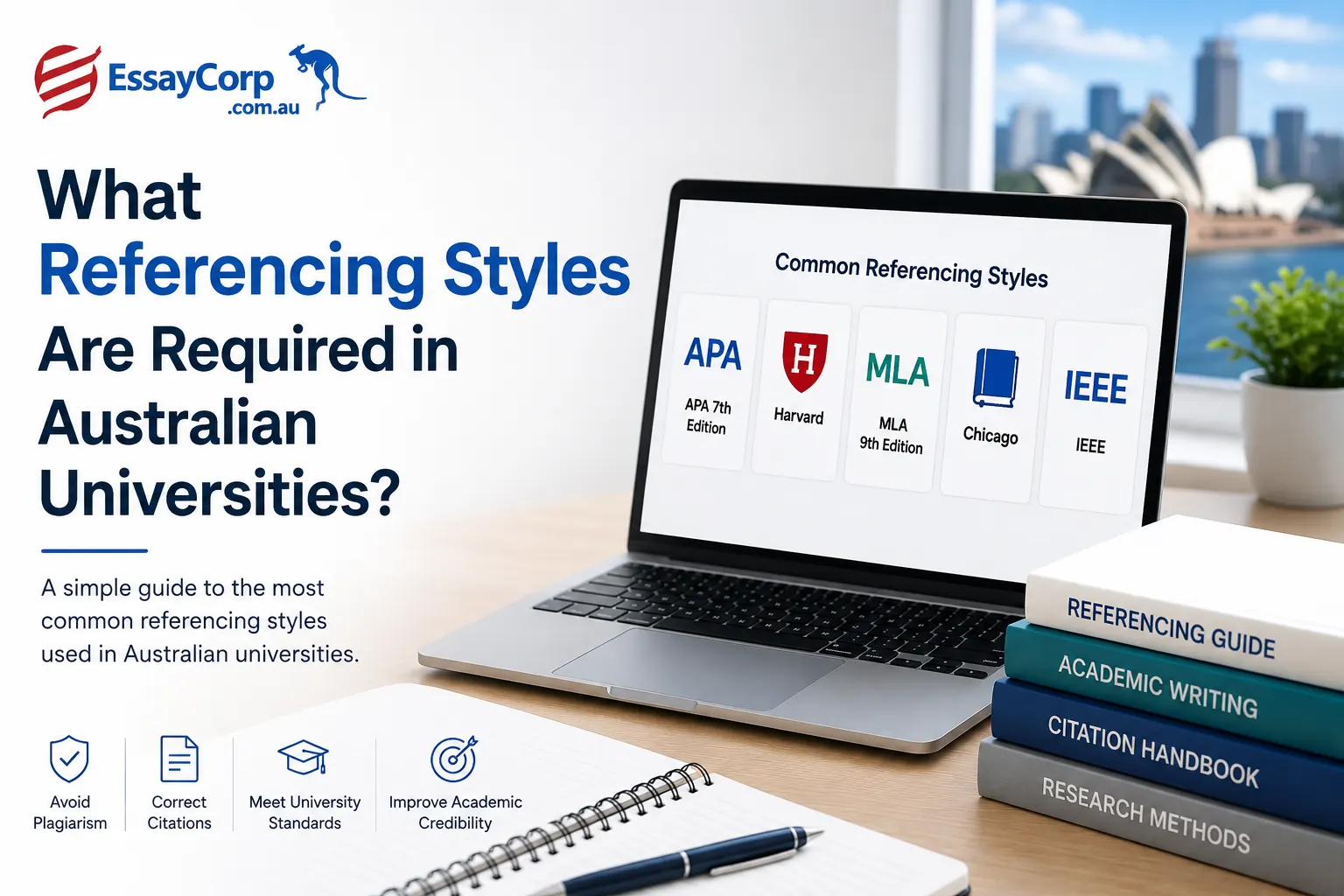
If you've ever stared at your assignment brief wondering whether your lecturer wants APA, Harvard, or something called OSCOLA, you're not alone. Referencing confuses even the sharpest students because every Australian university — and often every faculty within it — follows a different citation rulebook. This guide breaks down exactly which referencing style applies to your subject, why it matters for your grades, and how to get it right the first time.
Why Referencing Styles Matter in Australian Academic Writing
Referencing isn't just a formatting formality — it's proof of academic integrity. Australian universities use strict plagiarism-detection tools like Turnitin, and incorrect or missing citations can be flagged as academic misconduct even when the ideas are your own. A correct citation style also shows your marker that you've engaged with credible sources, which directly affects your grade under most Australian marking rubrics.
- Avoids plagiarism penalties and integrity breaches
- Builds credibility and demonstrates research depth
- Meets university-specific formatting requirements
- Helps markers trace your evidence back to reliable sources
- Improves overall structure and readability of your assignment
Popular Referencing Styles Used in Australian Universities
Australian institutions don't follow one universal format. Below are the referencing guides most commonly required across degrees, based on subject and faculty.
1. Harvard Referencing Style
The most widely used Harvard referencing format in Australia, especially for Business, Management, Marketing, and Commerce degrees. It uses an author-date in-text citation system with a corresponding reference list, and universities like Monash, RMIT, and Deakin have their own Harvard variations.
2. APA Style (American Psychological Association)
APA style is common in Nursing, Psychology, Education, and Social Science subjects. Australian universities typically follow APA 7th edition, which emphasises author-date in-text citations and a detailed reference list.
3. MLA (Modern Language Association)
MLA referencing appears mostly in Arts, Humanities, English Literature, and Media Studies assignments. It focuses on author-page number citations rather than dates.
4. Chicago Style
Chicago Style referencing is used in History, Philosophy, and some Fine Arts courses. It comes in two forms — Notes-Bibliography and Author-Date — and Australian universities usually specify which one applies.
5. OSCOLA (Oxford Standard Citation of Legal Authorities)
Any student studying a Law assignment will almost certainly need OSCOLA. It's the standard referencing system for legal cases, statutes, and journal articles across Australian law schools.
6. Vancouver Style
Vancouver Style is the go-to format for Medicine, Nursing, and Health Sciences degrees. It uses numbered in-text citations that correspond to a numbered reference list, closely aligned with biomedical journal standards.
7. IEEE Referencing
Engineering, Computer Science, and IT students commonly use IEEE referencing, which also relies on numbered citations and is standard for technical and scientific writing.
8. Turabian Style
A variation of Chicago style, Turabian is occasionally required in research-heavy humanities papers and postgraduate theses.
Referencing Style by Subject: A Quick-Glance Table
| Subject Area | Common Referencing Style |
|---|---|
| Management / Marketing / Accounting | Harvard, APA |
| Nursing / Health Sciences | APA, Vancouver |
| Law | OSCOLA |
| Economics / Finance | Harvard, APA |
| Computer Science / IT | IEEE, Harvard |
| English / Humanities | MLA, Chicago |
| Engineering | IEEE |
| Statistics | APA, Harvard |
How to Choose the Right Referencing Style
- Check your unit outline or assignment brief first — most Australian universities specify the exact style
- Confirm the edition (e.g., APA 6th vs 7th) since rules change between versions
- Ask your subject coordinator if the brief is unclear
- Use your university's official referencing guide or library page
- Stay consistent — never mix two referencing styles in one assignment
- Mixing in-text citation formats within the same document
- Forgetting to include page numbers for direct quotes
- Using outdated style editions (especially old APA 6th templates)
- Copy-pasting reference lists without formatting corrections
- Ignoring university-specific referencing variations (e.g., Deakin Harvard vs standard Harvard)
How EssayCorp Australia Helps With Referencing
Getting referencing exactly right across different subjects and universities can be time-consuming, especially when you're juggling multiple assignments and deadlines. EssayCorp Australia supports students with free referencing in Harvard, APA, OSCOLA, or any Australian style required, along with a free Turnitin report to confirm your work is 100% original before submission.
If your statistics unit is giving you trouble beyond referencing, it's worth understanding the core concepts before you start writing. Our related guide, Descriptive vs Inferential Statistics: What Every Australian Student Should Know, breaks down both concepts in plain language so you can apply the right method — and cite your sources correctly — in your next assignment.
Conclusion
Referencing styles vary widely across Australian universities and even between faculties within the same institution, so always check your assignment brief before you start writing. Getting familiar with Harvard, APA, OSCOLA, Vancouver, IEEE, and MLA early in your degree saves you time, protects your grades, and keeps your work plagiarism-free. When in doubt, lean on your university's official style guide — or get expert help to make sure every citation is accurate and consistent.
Frequently Asked Questions
Q. Which referencing style is most common in Australia?
Harvard and APA are the most widely used referencing styles across Australian university business and health courses.
Q. Do all Australian universities use the same Harvard style?
No, universities like Deakin and Monash have their own slightly different Harvard referencing variations.
Q. Which referencing style is used for law assignments?
Most Australian law schools require OSCOLA for citing cases, statutes, and legal journal articles.
Q. Can I mix two referencing styles in one assignment?
No, mixing styles is a common mistake and can cost you marks for inconsistency.
Q. Where can I check my university's required referencing style?
Always check your subject outline, assignment brief, or university library's referencing guide first.