How to Score HD Grades in University Assignments
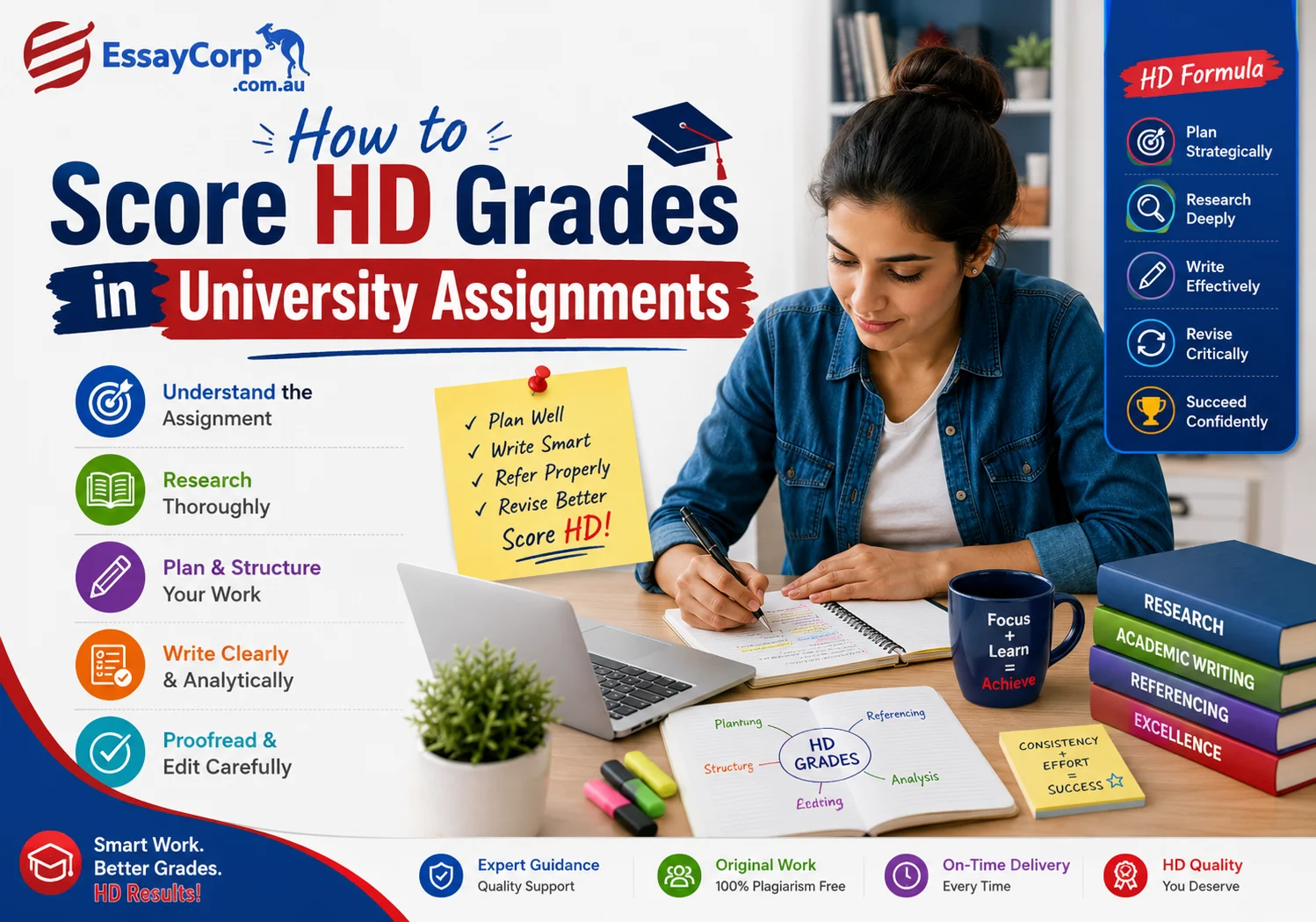
To score HD grades in university assignments, you need to decode the marking rubric, answer the exact question set, build a critical argument supported by credible evidence, reference accurately and edit in layers before submission. An HD (High Distinction) is typically awarded for marks of 85–100% in Australian universities, and it rewards analysis and original thinking rather than effort or word count.
This guide gives you a practical, step-by-step system used by high-achieving students. It also shows how to adapt it to your subject, use support services responsibly and stay safe under 2026 AI-assessment rules.
Quick Answer: The fastest route to an HD is to (1) break the question into task words, (2) map every rubric criterion to a section, (3) use current peer-reviewed evidence, (4) write analytically, not descriptively, (5) reference perfectly and (6) proofread in layers.
What Is an HD Grade in Australian Universities?
An HD, or High Distinction, is the highest grade in the Australian university grading system. It signals outstanding performance: deep subject knowledge, critical analysis, original thinking and flawless presentation. Most universities set the HD band at 85–100%.
|
Grade |
Typical Mark Range |
What Markers Expect |
|
HD (High Distinction) |
85–100% |
Insightful, original, critically evaluated |
|
D (Distinction) |
75–84% |
Strong analysis, minor gaps |
|
C (Credit) |
65–74% |
Sound understanding, some analysis |
|
P (Pass) |
50–64% |
Meets basic requirements |
|
F (Fail) |
Below 50% |
Does not meet requirements |
Always check your unit outline. Some universities, including Monash, use different thresholds, and several have renamed grades (for example, "DI" instead of "D"). Your unit guide is the final authority.
Why an HD Matters for Your Career
HD grades lift your WAM (Weighted Average Mark) and GPA, which affects honours eligibility, postgraduate admission, scholarships and graduate-program applications. Many employers in competitive fields such as law, accounting, nursing and consulting screen on academic results.
Why Most Students Miss the HD Band (and What Markers Actually Reward)
Most students miss HD because they describe instead of analyse, ignore rubric weightings and lose marks on referencing and structure. Effort rarely moves a mark from 78% to 85%. Precision does.
Common patterns that cap marks at Distinction or Credit:
-
Answering a different question from the one asked
-
Describing theory without applying it to the case, data or scenario
-
Weak or outdated sources such as general websites and old textbooks
-
Unclear thesis or argument that drifts
-
Referencing errors and inconsistent formatting
-
Last-minute submission with no editing time
Every one of these is fixable with a repeatable process.
Step 1: Decode the Assignment Question and Marking Rubric
Decoding the question means identifying the task word, the topic limits and the rubric criteria before you write anything. This is where HD students separate themselves from the rest.
Identify the Task Word
-
Describe – explain what something is
-
Analyse – explain how and why, breaking it into parts
-
Evaluate – judge how well something works, with evidence
-
Critically discuss – weigh arguments for and against and reach a position
-
Compare – show similarities and differences
-
Apply – use a theory or rule on a specific scenario
-
Reflect – link experience to theory and learning
An HD response almost always sits at the analyse, evaluate or critically discuss level, even when the question only says "discuss."
Read the Rubric Like a Marker
A marking rubric lists the criteria and performance levels used to grade your work. Look for:
-
Weightings: if critical analysis is worth 30%, it deserves roughly 30% of your effort and words.
-
HD descriptors: words like "insightful," "synthesises" and "original" show what the top band demands.
-
Hidden marks: formatting, referencing and structure often carry 10–20%.
If you are unsure what an assessment is asking, assessment help can clarify briefs, rubrics and expectations before you start drafting.
Step 2: Build a Structure That Mirrors the Rubric
A rubric-aligned structure gives each marking criterion its own visible home in your assignment. Markers scan for criteria, so make them easy to find.
A Simple Rubric-to-Structure Method
-
List every rubric criterion in a table.
-
Assign each criterion a section or paragraph group.
-
Allocate word count in proportion to marks.
-
Write a one-sentence thesis that answers the question directly.
-
Draft topic sentences for each paragraph before writing the body.
Standard HD-Friendly Essay Structure
-
Introduction (8–10% of words): context, thesis and roadmap
-
Body (80–85%): themed sections, each with claim, evidence, analysis and link
-
Conclusion (8–10%): synthesis, answer to the question and implications, with no new evidence
For essays, essay help can show you how strong thesis statements and paragraph structures look in practice.
Step 3: Research Like a High-Achieving Student
HD-level research relies on current, credible and relevant sources, ideally peer-reviewed journal articles, government reports, legislation, case law and recognised industry data. Quality beats quantity.
Where to Look (Without Wasting Time)
-
Your university library databases (start here, since your marker trusts them)
-
Unit readings and lecture references, which markers expect you to engage with
-
Recent publications from the last five to seven years, unless the topic is foundational
-
Australian context, such as local legislation, standards, case law and statistics, when the question is set in Australia
How to Evaluate a Source Quickly
Ask four questions: Who wrote it? Is it peer-reviewed? Is it recent? Does it directly support my claim? If any answer is no, find a better source.
Take Notes That Save Time Later
Create a simple research table with columns for the citation, key argument, useful evidence and how you will use it. This prevents the last-minute scramble and makes referencing nearly automatic.
For long research projects, dissertation help and research paper help can support literature reviews, methodology and chapter planning.
Step 4: Write with Critical Analysis (The Real HD Differentiator)
Critical analysis means evaluating evidence, comparing viewpoints, questioning assumptions and arguing a clear position, rather than summarising what sources say. It is the single biggest difference between a Distinction and an HD.
Use the PEEL-Link Paragraph Pattern
Point → Evidence → Explanation → Link
Example of Weak vs Strong Analysis
Weak: "Leadership theories describe how leaders behave."
Strong: "Transformational leadership improves engagement in service teams, but its effectiveness depends on organisational culture, which limits its application in highly regulated environments."
The strong version makes a claim, qualifies it and shows evaluative thinking.
Five Ways to Add Analytical Depth
-
Compare two theories and state which fits your case better, and why
-
Challenge an assumption in a source or framework
-
Apply theory to a real Australian example, dataset or scenario
-
Weigh limitations of a study or model
-
Synthesise multiple sources into one argument instead of listing them one by one
Write in Clear, Academic Language
Use precise vocabulary, avoid filler and keep sentences purposeful. Write in the tone your discipline expects: formal, evidence-led and objective, unless the task is reflective.
If you are building skills in structure and argument, English assignment help offers guidance on academic writing, literature analysis and essay organisation.
Step 5: Master Referencing (Easy Marks Most Students Lose)
Accurate referencing shows academic honesty and earns marks directly. Always use the style your unit requires and apply it consistently throughout.
Common Australian Referencing Styles
-
Harvard (Australian variants): business, health and social sciences
-
APA 7th edition: psychology, education, nursing and social sciences
-
AGLC4: law, for cases, legislation and secondary sources
-
Chicago, MLA, Vancouver and IEEE: humanities, medicine and engineering/IT respectively
Referencing Tips That Protect Your Grade
-
Reference as you write, not at the end.
-
Match every in-text citation to a reference list entry.
-
Check page numbers for direct quotes.
-
Paraphrase properly by changing structure and wording, not just swapping a few words.
-
Run a similarity check before submitting and review any matches.
Law students in particular should rely on law assignment help resources for AGLC4 and IRAC structure.
Step 6: Edit and Proofread in Layers
HD assignments are edited in layers, not in one rushed read-through. Each pass has a single purpose.
The 5-Layer Editing Method
-
Argument: does every section support the thesis?
-
Structure: do headings, paragraphs and transitions flow logically?
-
Clarity: are sentences concise and precise?
-
Grammar and spelling: read aloud or use a language-checking tool
-
Referencing and formatting: verify against the style guide and unit instructions
Step away for a few hours between drafting and editing. Fresh eyes catch more errors.
Subject-Specific Tips for HD Grades
The core method stays the same across subjects, but each discipline rewards different things.
Nursing Assignments
Nursing markers look for evidence-based practice, patient-centred care and clinical reasoning. Link every intervention to current guidelines and peer-reviewed research. For reflective tasks, use a model such as Gibbs. Nursing assignment help covers care plans, case studies, placement reports and reflective practice.
Aged Care and Healthcare Studies
Show person-centred thinking, ethical awareness and awareness of Australian standards. Aged care assignment help supports topics such as elderly wellbeing and care practices.
Law Assignments
Use IRAC (Issue, Rule, Application, Conclusion) for problem questions. Cite legislation and cases precisely under AGLC4, and apply the law to the facts instead of restating it.
Management and MBA Assignments
Connect theory with organisational practice. Frameworks like SWOT, PESTEL and Porter's Five Forces earn marks only when applied to the case, not merely named. Management assignment help can show how frameworks and case analysis are combined.
Marketing Assignments
Ground strategy in consumer insight and market data. Justify segmentation, positioning and campaign choices. Marketing assignment help supports marketing plans, brand analyses and research reports.
Accounting Assignments
Show formulas, assumptions and standards (including AASB where relevant). For software-based tasks, understanding the logic matters as much as the answer. Explore accounting assignment help, MYOB assignment help and Perdisco assignment help for bookkeeping, practice sets and reporting.
Finance Assignments
Present calculations clearly, state assumptions and interpret results in context. Finance assignment help covers valuation, investment analysis and risk management.
Economics Assignments
Use diagrams accurately, label axes and link models to real policy or market examples. Economics assignment help supports micro, macro and econometrics tasks.
Statistics and Data Analysis
Choose the right test and explain why it fits. Interpret results in plain language. Statistics assignment help and SPSS assignment help cover regression, ANOVA and hypothesis testing.
Computer Science and IT
Write clean, well-commented code and document your design decisions. Computer science assignment help covers Python, Java and database tasks.
Engineering and CDR Reports
Precision, units and standards matter. Migration-focused engineers can explore CDR report writing guidance for career episodes and CPD.
How to Aim for HD in the AI Era (2026 Rules You Need to Know)
AI tools can help you learn, but your university sets the rules for assessed work. Always check your unit outline for permitted AI use before you begin. Turnitin's recent reporting shows that AI use is now visible in more than half of Australian tertiary submissions it processed, and TEQSA's regulatory focus means universities are tightening their approach to assessment integrity.
Practical, Policy-Safe Habits
-
Read your unit's AI statement (many use "open" vs "secure" assessment categories)
-
Use AI only as permitted and acknowledge it when required
-
Verify every fact and reference, since AI can invent sources
-
Write in your own voice, because markers reward original thinking
-
Keep drafts and notes as evidence of your process
HD-level work is human-led: your argument, your analysis and your evidence choices. Generic text rarely hits the top band because it lacks specific application to your brief.
Time Management: The Hidden HD Skill
Starting early is one of the strongest predictors of a higher mark. Students who plan backwards from the due date allow time for research, drafting, a break, revision and referencing.
A Simple 14-Day Assignment Timeline
-
Days 1–2: Decode the question and rubric; build your outline
-
Days 3–6: Research and note-taking
-
Days 7–10: Draft body sections and introduction
-
Days 11–12: Revise for argument and structure
-
Day 13: Edit, reference and format
-
Day 14: Final proofread and submit early
If you are juggling work, placement or study in a second language, early guidance helps. Coursework help and online exam help can support planning, practice questions and revision strategies across the semester.
How Expert Academic Support Can Help You Aim for HD
Academic support works best when it builds your skills: model answers to study, feedback on drafts, referencing checks and subject explanations. EssayCorp is an online academic support service for Australian students, offering assignment help Australia wide across 120+ subjects, with subject-matched experts, a free Turnitin report, free referencing and free revisions.
Students often search for phrases like do my assignments when deadlines pile up. If you use any service, treat the material as a reference and learning aid, follow your university's academic integrity policy and never submit someone else's work as your own.
How to Use Support Responsibly
-
Share your full brief, rubric and referencing style so guidance is accurate.
-
Ask for explanations, not just answers.
-
Study the structure of model responses and apply the moves in your own writing.
-
Request feedback on your draft before the due date.
-
Check current offers on the offers page to plan support affordably.
Ready to get a quote? Visit the order page with your brief and deadline.
10 Common Mistakes That Stop Students Reaching HD
-
Ignoring the rubric weightings
-
Writing descriptively instead of analytically
-
Using weak, outdated or non-academic sources
-
Starting the assignment in the final week
-
Skipping a clear thesis statement
-
Referencing inconsistently or at the last minute
-
Overusing direct quotes instead of paraphrasing with analysis
-
Not applying theory to the specific case or scenario
-
Failing to proofread
-
Not reading feedback from previous assignments
Fix even three of these and your next mark is likely to rise.
Your HD Assignment Checklist
-
I answered the exact question and task word
-
Every rubric criterion has a visible section
-
My thesis is clear, specific and arguable
-
Each paragraph follows claim, evidence, analysis and link
-
Sources are current, credible and relevant
-
All citations match my reference list
-
I followed word count, formatting and style rules
-
I checked AI-use rules for this assessment
-
I edited in layers and proofread at least once
-
I submitted early, not at the deadline
For more study guides, subject tips and assignment strategies, browse the EssayCorp blog.
Conclusion
Scoring HD grades in university assignments is not about luck or working longer hours. It comes from a repeatable system: decode the question and rubric, structure your answer around the marking criteria, research with credible sources, write critically, reference precisely and edit in layers. Add subject-specific tactics and responsible, policy-safe study habits, and an HD becomes a realistic target.
Start with your very next assignment. Break down the rubric, plan early and apply one new technique from this guide. If you want expert guidance with briefs, structure, referencing or subject concepts, explore assignment help in Australia and submit your details through the order page for a clear quote.
Frequently Asked Questions
Q. What percentage do you need for an HD in Australian universities?
Most Australian universities award an HD for 85–100%. A few institutions, such as Monash, set the threshold at 80%. Always check your unit outline, because grade bands and names can differ between universities and units.
Q. How can I get an HD in my university assignment?
Break down the question and rubric, build a structure that mirrors the marking criteria, use current peer-reviewed sources, write critically instead of descriptively, reference accurately and edit in layers. Starting early and applying feedback from earlier assessments also helps significantly.
Q. Is it hard to get an HD at university?
Yes, HDs are awarded selectively because they require outstanding analysis and originality. However, consistent technique makes them achievable. Rubric alignment, strong evidence, critical thinking and polished referencing separate HD work from Distinction-level work.
Q. Can assignment help services help me aim for HD grades?
Academic support can help you understand briefs, structure arguments, learn referencing and study model answers. Use it as a learning aid, follow your university's academic integrity policy and never submit another person's work as your own. Services like EssayCorp offer subject-matched guidance for this purpose.
Q. Can I use AI to get HD grades in my assignments?
Only if your unit's rules allow it. Many Australian universities now classify assessments as open or secure for AI use. Even when AI is permitted, verify all facts and references, acknowledge use if required and write in your own analytical voice.